
This article was originally published on SaportaReport.
What does it take to create a public park?
The City of Atlanta has bolstered its parks inventory in recent years with acquisitions like Red’s Farm Preserve, Tatum Lakes and the Lucinda Bunnen property. The benefits of these properties are immense — providing access to greenspace in parts of the city that need it while also protecting mature forests (especially crucial in light of a recently released 2023 study showing that Atlanta’s tree canopy has declined from 47.9 percent in 2008 to 45.5 percent. More on SaportaReport).
While the prospect of a new greenspace is exciting for many, creating a park is no small feat, and it takes a village to build a great one, including landowners, community members, the City, nonprofit partners, private philanthropy, and many more.
In some cases, like Red’s Farm and Tatum Lakes, these spaces are already used informally and beloved by neighbors. The transition between “used informally” and “public parks” could not happen without the City, particularly the Department of Parks and Recreation, playing a central role in leading and overseeing local park acquisition efforts. Local nonprofits like The Conservation Fund (TCF), Park Pride, Trust for Public Land and the Atlanta Beltline, Inc. are crucial in converting these unofficial greenspaces or private land into publicly accessible parks. Park Pride and TCF have worked together on many projects, including Mattie Freeland Park, Kathryn Johnston Memorial Park, Lower Paul Ave Park and, more recently, Red’s Farm.
TCF recently hit a major milestone — acquiring over 1,000 acres of parks and greenspace in the City of Atlanta over the last 20 years, which is the equivalent of over five Piedmont Parks.
Roberta Moore, TCF’s Senior Field Representative, points to the Tree Trust Fund under Atlanta’s Tree Protection Ordinance as an important tool that’s enabled the team to increase acquisitions in recent years. That Fund comes from fees paid by developers, builders and property owners when healthy trees are cut down.
When considering which properties to pursue on behalf of and in partnership with the City, TCF looks for land to expand existing parks, spaces that would connect existing parks so visitors can safely navigate between them, and areas where the community wants more greenspace or to protect an important ecosystem.
“The large tracts of land with mature forests and habitats are dwindling,” Moore said. “It’s a little bit of a race to try to continue to protect those spots that have been identified as ecological hotspots in the city.”
She continued: “The really big swaths of land, like Tatum Lakes (50 acres) and Lake Charlotte (216 acres), are really critical for our green infrastructure as we continue to experience impacts from climate change but are also really important for ensuring that Atlantans in every corner of the city can continue to access nature in some way, even as we continue to develop.”

Moving from identification to acquisition to open access takes many steps: Once the terms are confirmed, TCF purchases the land and serves as the interim holder for the City as they work on funding and passing legislation. From there, the planning process begins, which typically includes establishing a resident-led Friends of the Park group with Park Pride. Moore emphasized that community buy-in is a crucial piece, “because at the end of the day, if this is not something that they are seeking out, then it’s not going to be a resource that people enjoy or are going to care for.”
From identification to official opening, four years is the fastest timeframe Moore has seen. Her motto is “Sometimes to go fast, you have to go slow.”
While acquisition protects the land, it doesn’t make a park — that’s where Park Pride and Friends of the Park groups come in. Take Red’s Farm in Ormewood Park, for example. Red’s Farm is a 5.25-acre plot that Brian “Farmer Red” Harrison stewarded as farmland for 30 years and served as a community farm for 16 years. He passed away in 2022, and his family sold the land to become a public park, which officially opened last year.
Urban Farm in Ormewood, a nonprofit that oversees the land, asked Park Pride’s Vision team of park designers for help in preparing for increased visibility and visitor traffic as Red’s Farm transitions to a city park — requiring a thoughtful design to balance the park’s ecological diversity, gathering spaces, community gardens, orchards, and creek.
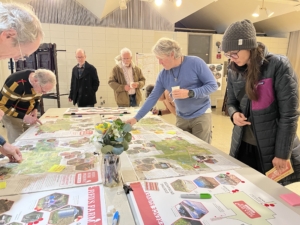
Projects like these are at the heart of Park Pride’s mission, and the team was up for the challenge. Through months of dreaming and planning with the community, the recently completed vision plan charts a path forward guided by what matters most to neighbors: protecting the land’s natural habitats, deepening access for growers and visitors of all ages and abilities, and keeping regenerative farming at the heart of it all. The plan includes areas for play using natural materials, places to gather, accessible pathways, and more.
“Some of our most resilient parks are created organically — selected for the right amount of sunlight, water, space and, ultimately, how they feel. Red’s Farm formed that way,” Park Pride’s Director of Visioning Teri Nye said. “Park Pride is honored to help give form to a vision for this park. We’re grateful to people, like Farmer Red, who see places for community, and to the neighborhood and Red’s family for understanding the value of preserving this special space.”
Urban Farm of Ormewood Chairperson Rachel Ezzo added: “The park visioning process brought the community together to shape a shared vision for Red’s Farm Preserve. As a small, volunteer-run nonprofit, access to this level of planning expertise was invaluable. The process allowed us to thoughtfully explore the property’s future while honoring the land itself, the legacy of Brian Harrison (Farmer Red), and the priorities expressed by the community.”
Residents are excitedly awaiting news about two other recent acquisitions. Purchased by the City earlier this year, Tatum Lakes is an urban forest sitting along Boulder Park Drive and is home to old-growth white oak, pine and hickory trees, two man-made lakes, wetlands and a small waterfall. The nature preserve is expected to open next year, according to the AJC.

This summer, the City acquired local photographer and philanthropist Lucinda Bunnen’s property in Buckhead with 30 acres of contiguous forest — an incredibly high-value and rare property for the area. That’s why, when the property went on the market in 2023, TCF knew they had to act fast. Little Nancy Creek and two miles of trails run through the property. Councilmember Mary Norwood points to Cascade Springs Nature Preserve as an example of the future of this property, sharing that the forest will remain intact, and the trails will open to the public as early as next year.
Acquisition and design efforts like these are crucial as we work toward an Atlanta where everyone has easy access to a quality park. Our latest #18 ParkScore ranking (out of the 100 most populous U.S. cities) was our highest ever, and we were also highlighted as the city with the most progress in the last decade — all showing that we are on the right path.